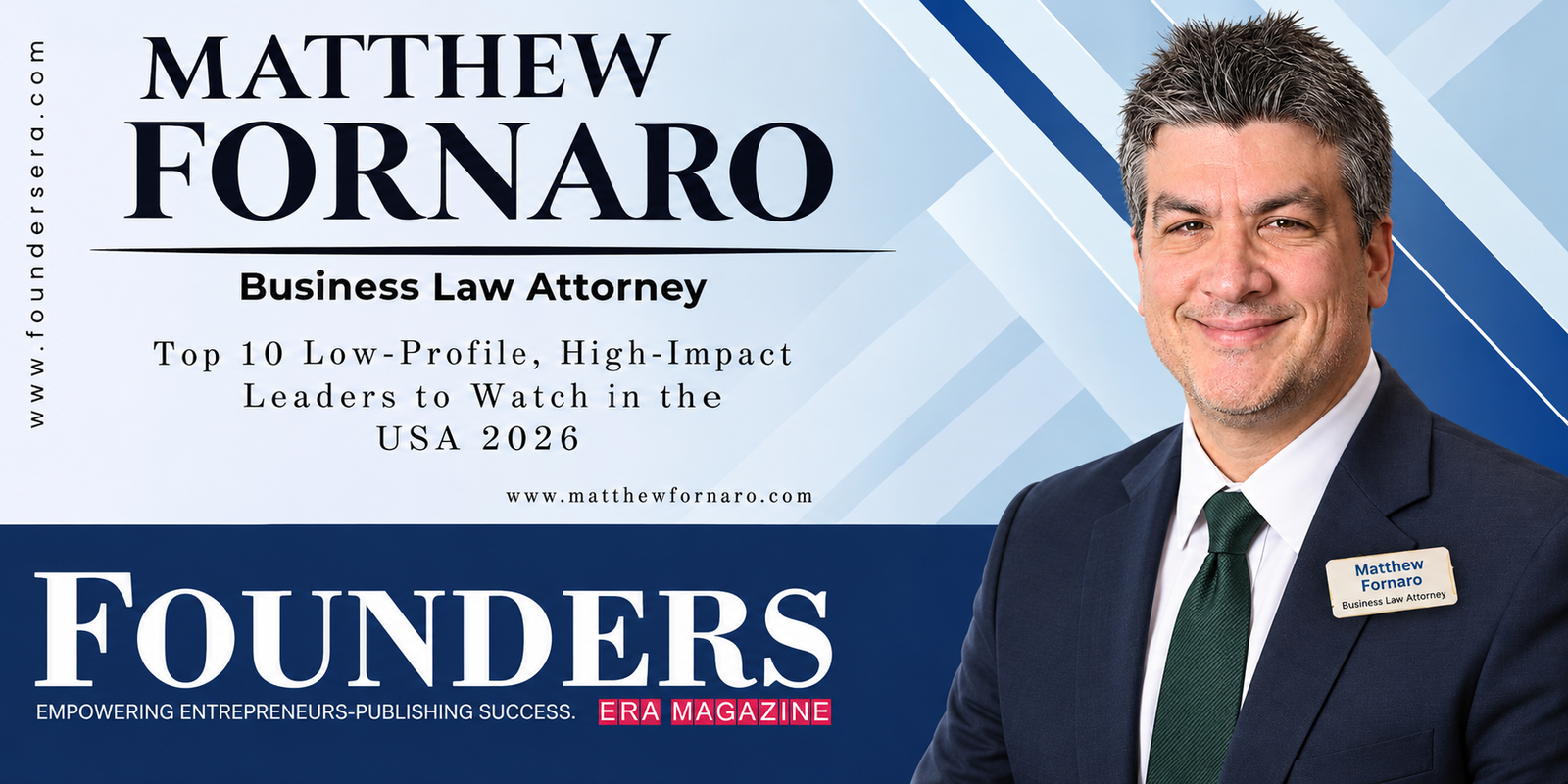
A Business Lawyer Shaped by Both Sides of the Table
For entrepreneurs, legal problems rarely remain confined to the legal file. A contract dispute can become a cash-flow problem. An ownership disagreement can threaten operations. A poorly documented business relationship can affect financing, customer confidence, or a future sale. The law matters, but so do timing, cost, leverage, relationships, and the ability to keep the business moving.
That intersection has defined much of Matthew Fornaro’s career. Fornaro, founder of Matthew Fornaro, P.A., doing business as Fornaro Legal, has practiced law since 2003 and has built a South Florida business-law practice around a practical premise: effective legal advice should help a client make a better business decision, not simply identify what the law permits.
His perspective comes from more than two decades of litigation, transactional work, contracts, dispute resolution, and business counseling. It also comes from owning and operating his own firm. That combination has given him a view of legal risk from both sides: as an attorney analyzing a problem and as a business owner who understands that every decision competes with budgets, deadlines, customers, technology, staffing, reputation, and growth.
For Founders Era’s “Top 10 Low-Profile, High-Impact Leaders to Watch in the USA – 2026,” that quieter form of influence is central to Fornaro’s story. His professional identity is not built around legal theater or visibility for its own sake. It is built around preparation, candid advice, practical judgment, and helping business owners preserve options before those options disappear.
An Early Interest in Disputes, and a Personal Connection to Business
Fornaro’s interest in law began before he fully understood what practicing law would involve. He was drawn to the way disputes could be reduced to facts, rules, credibility, and a decision. Even television courtroom programs captured his attention because they offered a simplified view of something he would later encounter professionally: two sides can look at the same events and tell very different stories.
His connection to business law was more personal. His father operated a successful small business, giving Fornaro an early look at the responsibilities that come with ownership. Business owners are not simply pursuing revenue. They are managing customers, employees, vendors, cash flow, family obligations, opportunities, and risk, often at the same time.
That background shaped how Fornaro later viewed the role of counsel. Smaller companies may not have legal departments, compliance teams, or layers of management, but the legal decisions they make can be just as consequential to the future of the enterprise as those made by a much larger organization.
After earning his Juris Doctor from the University of Florida Levin College of Law, Fornaro began practicing in 2003. His early work included civil and commercial litigation, and his career later included larger law-firm environments, including AmLaw 200 firms. Those settings exposed him to sophisticated disputes, institutional clients, structured systems, and the level of preparation expected when significant financial and commercial interests are at stake.
From Established Firms to an Independent Practice
The move from established firms to an independent practice was not simply a change in workplace. It changed Fornaro’s perspective on the problems his clients were bringing to him.
In 2015, after more than a decade in practice, he founded Matthew Fornaro, P.A. The goal was not to reproduce a large-firm model on a smaller scale. It was to bring disciplined legal analysis directly to entrepreneurs, startups, executives, investors, and established companies while keeping the advice connected to the business problem that made the legal issue important in the first place.
Operating the firm gave Fornaro firsthand exposure to many of the same pressures his clients face. He became responsible not only for legal work, but also for client relationships, technology, finances, marketing, workflow, reputation, and long-term planning. That experience sharpened an important distinction: the theoretically safest legal answer is not always the most commercially sensible answer.
Businesses cannot operate in a world of zero risk. The more useful question is which risks matter, which can be reduced or allocated, which can be reversed, and which may be worth accepting because the opportunity justifies them. Fornaro’s role is to help clients understand that landscape well enough to make an informed decision.
Leadership Through Preparation, Candor, and Accountability
Fornaro’s leadership philosophy is deliberately practical. He values preparation, responsibility, direct communication, and accountability. Clients should understand what is happening, what their realistic options are, and what the next decision will require.
That means difficult information cannot be postponed simply because it is uncomfortable. If a case has a weakness, if a contract creates an unexpected obligation, or if a client’s preferred outcome is unlikely to be available, Fornaro believes the lawyer has to say so clearly. Candor is part of professional responsibility, but it is also part of sound strategy. A client who understands the weakness can plan around it; a client protected from bad news cannot.
He also distinguishes between assertiveness and unnecessary aggression. Some matters require immediate and forceful action. Others are better served by negotiation, mediation, arbitration, or a structured business solution. In his view, litigation is a tool, not an identity. The right strategy is the one that best advances the client’s lawful objective.
This approach reflects a broader understanding of leadership. Good leaders do not simply announce positions. They understand the objective, evaluate the available information, make decisions, communicate expectations, and accept responsibility for the result.
Building Trust by Making Legal Advice Understandable
Trust is especially important in business law because clients often seek advice at moments of uncertainty. They may be deciding whether to sign a major agreement, confront a business partner, terminate a relationship, pursue litigation, or accept a compromise. Those decisions can affect money, reputation, operations, and years of work.
Fornaro believes trust develops through consistency rather than promises. Clients should expect preparation, responsiveness, realistic assessments, and clear explanations of cost, risk, and uncertainty. He does not believe in guaranteeing outcomes that cannot be guaranteed.
Communication therefore plays a central role in his practice. Rather than leaving a client with a long explanation of doctrine, he tries to translate the issue into choices: What happens if the company takes this path? What happens if it does nothing? What leverage exists? What will the decision likely cost? What could it mean six months from now?
Long-term relationships also improve the quality of legal advice. When counsel understands how the company makes money, which relationships matter, where the owner wants the business to go, and what risks are most important, the advice becomes more useful. The immediate file still matters, but so does the pattern behind it.
Legal Foundations That Keep Pace with Growth
One recurring problem in growing companies is that the business changes faster than its legal structure. A company adds customers, employees, contractors, investors, technology, locations, or new lines of business, while its contracts and governance documents still reflect an earlier stage.
Fornaro encourages founders to establish a clear legal foundation early. That begins with an appropriate entity and written documentation of ownership, management authority, voting rights, capital contributions, and exit rights. Where multiple owners are involved, the governing agreement should address difficult questions while the relationship is still strong: What happens if the owners disagree? If one stops contributing? If additional capital is needed? If someone wants out? If the company is sold?
The same discipline applies to intellectual property. A business should know who owns the work created by founders, employees, contractors, developers, designers, and outside vendors. Customer and vendor contracts should reflect the way the company actually operates. Confidential information should be protected. Payment obligations, termination rights, personal guarantees, indemnification, limitations of liability, and dispute-resolution terms should be understood before they become relevant in a conflict.
Fornaro’s point is not that every small company needs elaborate legal infrastructure. It is that the relationships capable of materially affecting the company deserve clear rules. Legal structure should support momentum, not interrupt it.
Preventing Disputes Before Leverage Disappears
The most valuable legal work is often invisible because the problem never becomes a lawsuit. Businesses usually have more flexibility before a relationship deteriorates. Once money is owed, trust is gone, or litigation has begun, the available choices may narrow quickly.
Fornaro regularly sees disputes that grew from assumptions rather than deliberate decisions. Partners relied on verbal understandings. A customer relationship expanded without updating the contract. A vendor agreement renewed automatically. An employee or contractor created valuable work without clear ownership terms. A manager made commitments without defined authority.
A disciplined contract process can reduce that risk. Companies should know which terms matter, who can approve deviations, where signed agreements are stored, when agreements renew or terminate, and who owns responsibility for maintaining them. Those systems become increasingly important as the company grows.
This preventive approach is not about trying to eliminate every possible dispute. It is about preserving options. A company with clear records, current agreements, defined authority, and organized ownership documentation is better positioned when a financing opportunity, sale, audit, dispute, or unexpected transition occurs.
The Attorney as Strategic Business Adviser
Fornaro sees the role of business counsel continuing to move beyond reactive representation. Litigation, transaction documents, and legal research remain essential, but business owners increasingly need advisers who can connect legal analysis to commercial consequences.
That requires understanding more than the legal issue. Counsel should know how the company operates, how the transaction affects revenue, which relationships are important, what the owner is trying to preserve, and whether the legal strategy is proportionate to the risk.
Fornaro’s work in entrepreneurship education reinforces that perspective. He is involved with programs including Kauffman FastTrac, Florida State University’s Jim Moran Institute for Global Entrepreneurship, and SCORE. Teaching founders requires legal concepts to be translated into practical decisions, and it keeps him close to the questions entrepreneurs are asking before those questions become lawsuits.
The recurring lesson is that sophisticated legal advice does not need to be inaccessible. The best business counseling is often the advice that makes a complex issue easier to act on.
Technology, AI, and the Need for Corporate Memory
Artificial intelligence and digital business tools are changing how companies communicate, create information, and make decisions. Fornaro does not treat AI as a completely separate category of law. Instead, he sees new technology creating new versions of familiar questions involving confidentiality, intellectual property, authority, contracts, representations, and accountability.
Businesses need to know what information employees may place into public AI systems, who owns AI-assisted work, what vendor terms permit, and what customer-facing systems are allowed to say or do. Where automated tools quote prices, communicate contractual terms, or make decisions inside company workflows, authority and human oversight matter.
Another issue is corporate memory. Important decisions are now spread across email, text messages, collaboration platforms, cloud systems, AI tools, and personal devices. If a business later cannot explain who approved a decision, which version of an agreement controlled, or what an automated system was permitted to do, the problem becomes both legal and operational.
For law firms, technology can improve research, drafting, organization, and workflow, but Fornaro believes it cannot replace professional judgment. Lawyers remain responsible for verifying their work, protecting confidential information, understanding the client’s objective, and standing behind the advice they provide.
Professional Recognition Without Losing Perspective
Fornaro’s professional background includes more than two decades of business law, commercial litigation, transactions, and dispute resolution. He is admitted in Florida, New York, and the District of Columbia and has developed a practice that includes contracts, governance and ownership disputes, business transactions, construction and real-estate conflicts, mediation, and arbitration.
His professional recognitions include an AV Preeminent® Peer Review Rating from Martindale-Hubbell and recognition in The Best Lawyers in America® for Commercial Litigation since 2022. His dispute-resolution credentials include service as a Florida Supreme Court Certified County Mediator, a Florida Supreme Court Qualified Arbitrator, and a FINRA Dispute Resolution Arbitrator.
He views those credentials as meaningful, but not as the definition of the work. Reputation is built through accumulated conduct: being prepared, giving candid advice, meeting commitments, communicating clearly, and exercising judgment when the answer is not obvious.
That outlook is consistent with the “low-profile, high-impact” theme of the Founders Era feature. Fornaro’s focus is less on projecting an image of success than on building a practice clients can rely on over time.
Looking Toward 2027: Growth with Discipline
Fornaro’s priorities for 2027 and beyond center on thoughtful growth without losing direct client relationships. He intends to continue developing work with entrepreneurs, founders, executives, investors, and established businesses, including companies with meaningful connections between Florida and New York.
He expects AI governance, digital evidence, intellectual property ownership, founder and partner disputes, contract management, corporate memory, and internal decision-making authority to become increasingly important as businesses operate faster and across more systems.
He also plans to continue teaching, mentoring, writing, speaking, and participating in media and entrepreneurship education. Those activities serve the same larger objective as his legal practice: helping business owners identify important issues earlier, understand their choices, and make better-informed decisions while they still have options.
Growth, in his view, is not an end in itself. The objective is to expand the firm’s usefulness without sacrificing responsiveness, credibility, or the practical approach that led him to build the practice in the first place.
Success, Family, and the Legacy of Useful Counsel
Fornaro does not define success by a single case, award, or financial result. Professionally, success means doing work he is proud of, helping clients protect what they have built, earning trust over time, and maintaining integrity even when the advice is difficult.
Personally, that definition includes maintaining perspective outside the office. Spending meaningful time with his family remains his first priority away from work. His other interests include American history, aviation, trivia, and Formula 1, but family is the center of the balance he tries to preserve.
His advice to younger attorneys and entrepreneurs is simple: believe in yourself, have a plan, and execute on it. Preparation matters, but plans must remain flexible. Make the best decision possible with the information available, measure the result, and adjust when circumstances change.
The legacy Fornaro hopes to leave is equally straightforward. He wants clients to feel that they had access to experienced counsel who understood what they were trying to build, told them the truth, protected what mattered, and helped them make better decisions. In a profession where every matter can become complicated, usefulness may be the most durable measure of impact.