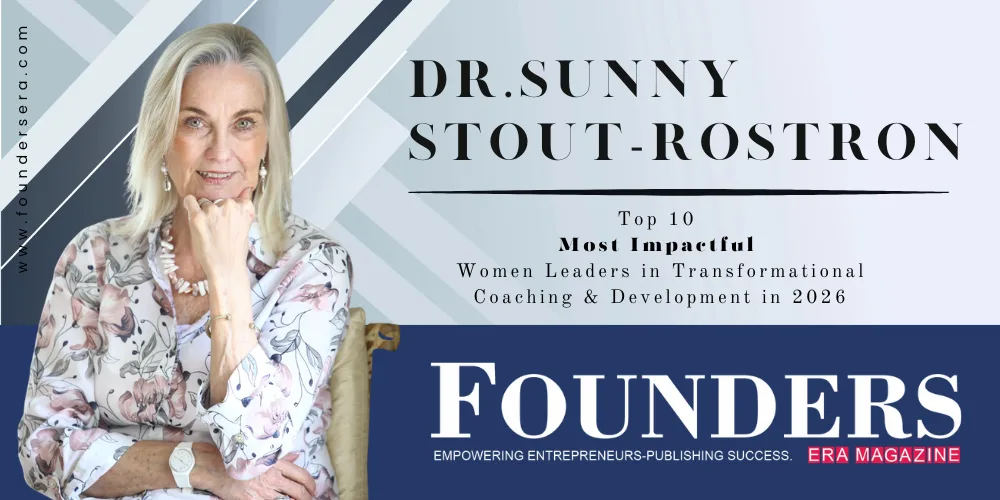
Dr. Sunny Stout-Rostron: Transforming Leadership Through Emotional Intelligence and Human-Centered Coaching
In a world where leadership is increasingly measured not only by performance metrics but by emotional maturity, resilience, and the ability to inspire meaningful change, few voices have contributed as profoundly to transformational coaching and leadership development as Dr. Sunny Stout-Rostron. With more than 25 years of international experience spanning corporate leadership, executive coaching, academia, and transformational learning, Dr. Sunny has established herself as one of the most impactful women leaders in transformational coaching and development in 2026.
Her journey into executive coaching was not born from corporate ambition alone, but from an innate calling to help people grow. Long before coaching became a globally recognized profession, she naturally stepped into mentoring and leadership roles during her teenage and university years. Supporting others, helping them think clearly, and enabling them to recognize their own potential came instinctively to her.
“For me, it was never about being an expert,” she reflects. “It was about creating the conditions for others to grow.”
That philosophy would later become the foundation of a remarkable career dedicated to helping leaders evolve not just professionally, but personally and emotionally.
A Career Built Across Industries and Continents
Before transitioning fully into executive coaching, Dr. Sunny spent nearly two decades working in blue-chip organizations across the United States and the United Kingdom. Her experience spanned industries as diverse as a television presenter, followed by executive positions in hospitality, feminine hygiene, and newspaper marketing, where she held leadership positions.
Throughout these roles, one consistent pattern emerged: organizations needed stronger leadership development, and leaders themselves needed greater emotional awareness and human-centered management skills.
Initially, she brought external consultants into organizations to support leadership growth. Over time, however, she began designing her own leadership and development programs tailored to the specific needs of teams and businesses. Her commitment to continuous learning drove her to pursue advanced education, including a master’s degree and eventually a professional doctorate in executive coaching grounded in cognitive behavioral psychology.
Ironically, one of the defining turning points in her career began not in a boardroom, but over coffee.
After leadership workshops and team development sessions, senior executives would often ask her to stay behind for informal conversations. During these moments, she began noticing something remarkable: leaders were leaving those conversations with greater confidence, stronger emotional intelligence, and deeper self-awareness. Many went on to take on larger leadership responsibilities and more senior positions.
That experience led her to recognize the powerful and often underestimated relationship between emotional intelligence and organizational success.
Redefining Leadership Through Emotional Intelligence
At the heart of Dr. Sunny’s work lies a belief that business effectiveness cannot be separated from emotional awareness. Her clients became her greatest teachers, inspiring her to focus deeply on emotional intelligence as a critical component of leadership development.
Working closely with executive leaders and their teams exposed her to the realities of modern organizational life: increasing complexity, cultural diversity, competing priorities, and workplace conflict. She observed that without emotional awareness, leaders often struggled to navigate difficult behaviors, communication barriers, and cultural nuances effectively.
“Business has long behaved as though emotions have no place at work,” she explains, “yet they sit at the heart of human effectiveness.”
According to Dr. Sunny, emotional intelligence is not separate from cognitive intelligence; the two are deeply interconnected. Emotions shape judgement, humility, motivation, compassion, and decision-making. When organizations suppress emotional expression in pursuit of performance alone, authenticity suffers and leadership becomes disconnected from humanity.
Her work challenges traditional leadership models that prioritize authority and control over reflection, empathy, and conscious development. Instead, she advocates leadership that recognizes people as whole human beings rather than merely job titles or productivity units.
A Global Perspective on Human Development
Dr. Sunny’s international journey has significantly shaped both her worldview and coaching philosophy. Having lived and worked across the northern and southern hemispheres, including the United States, the United Kingdom, France, and South Africa, she has developed a rich understanding of cultural complexity and human behaviors.
Growing up in San Francisco during the transformational rise of Silicon Valley, amid the Vietnam era and the Civil Rights movement, exposed her early to social change, personal loss, and societal transformation. These formative experiences cultivated an awareness of resilience, identity, and the importance of human connection.
Each country and culture she encountered deepened her understanding of leadership, language, learning, and change. More importantly, these experiences reinforced her belief that transformational coaching must move beyond transactional performance conversations.
She explains that telling leaders what to do rarely creates lasting change. True transformation occurs when leaders are given reflective space to wrestle with complexity, challenge assumptions, and arrive at their own insights.
“At its best, coaching opens a conversation that reaches not only the head, but also the heart,” she says.
This developmental approach allows leaders to strengthen judgement, deepen maturity, improve team effectiveness, and ultimately transform organizational performance.
From Performance to Conscious Leadership
One of Dr. Sunny’s most distinctive contributions to transformational coaching is her framework of moving leaders from “doing” to “learning” to “being.”
Many clients initially seek coaching because they want to improve performance, resolve conflict, or achieve specific business goals. While these objectives are important, Dr. Sunny believes meaningful transformation requires leaders to go deeper.
The coaching journey begins with identifying the issue or desired outcome. However, real work lies in helping leaders understand what they need to learn to evolve. This includes examining thought patterns, emotional responses, behaviors, and unconscious assumptions that may limit their effectiveness.
As the process deepens, leaders begin asking more profound questions:
· Who do I want to become as a leader?
· How do I relate to others?
· What kind of impact do I want to create?
This evolution ultimately transforms unconscious leadership into conscious leadership.
For Dr. Sunny, transformational leadership is fundamentally human and developmental. It equips leaders to navigate diversity, conflict, systemic complexity, and organizational pressure with greater courage, awareness, and authenticity.
Addressing the Challenges Facing Modern Executives
Having coached senior executives and board-level leaders globally, Dr. Sunny has witnessed firsthand the immense pressures facing today’s business leaders.
Among the most common challenges she identifies are:
· Difficulty executing organizational strategy effectively
· Competing agendas across leadership teams
· Long working hours and relentless pressure
· Limited time and resources
· Workplace politics and systemic tensions
· Declining personal wellbeing and work-life balance
She notes that many executives have never been adequately prepared for the emotional and political realities of organizational life. As a result, stress, burnout, and disconnection often become normalized.
One of the issues she feels most strongly about is the erosion of time for personal life and family relationships. Leaders frequently sacrifice their physical, emotional, and spiritual wellbeing in pursuit of professional success.
Dr. Sunny emphasizes that sustainable leadership requires intentional self-care through sleep, nutrition, exercise, emotional support, and reflective practice.
“Work should sustain life, not steal it,” she says.
Her own life experiences, including living with Crohn’s disease, reinforced the importance of health, balance, and listening before the cost becomes too great. She openly acknowledges that illness became one of her greatest teachers, reminding her of life’s fragility and humanity’s deep dependence on love and support.
One of the major achievements of her career ꟷ also one of its most profound learning experiences ꟷ was her leading role in establishing COMENSA, the professional body for coaches and mentors in South Africa which just celebrated its 20th anniversary. This process took four years and involved travelling across the country to consult with practitioners in coaching, mentoring, counselling, psychology and learning development. It was a collective effort and a huge learning experience for herself, and all concerned, emphasizing the imperative of consultation, collaboration and above all listening attentively to all the voices. Today, COMENSA stands as a robust organisation that oversees, nurtures, and promotes the profession, while maintaining close ties with similar organisations around the world and supporting the development of related bodies in other African countries. As Founding President, Dr. Sunny regards this contribution as an important part of her legacy.
The Power of Reflective Conversations
Central to Dr. Sunny’s methodology is the creation of meaningful coaching conversations rooted in trust, respect, and honesty.
She believes transformational change cannot happen without psychological safety and genuine openness. Clients must be willing to acknowledge behaviors or patterns that may no longer serve them well and develop the courage to change.
Coaching, in her view, is not a sign of weakness or failure; it is a disciplined commitment to growth.
Her doctoral research at Middlesex University deepened this understanding further. Through her studies, she explored what clients were truly experiencing psychologically, emotionally, spiritually, and developmentally during coaching conversations.
The research also accelerated her own personal growth and helped her integrate her skills, talents, and life experiences into a more profound level of expertise.
Another major influence on her work has been Nancy Kline’s Thinking Environment™, which emphasizes deep listening, ethical practice, and creating spaces where people can think independently and clearly. This approach significantly shaped both her coaching and teaching philosophy and strengthened her commitment to human-centered leadership development.
The Future of Emotional Intelligence in Leadership
Looking ahead, Dr. Sunny believes emotional intelligence will become even more critical to organizational success, especially as organizations grapple with the rapid rise of artificial intelligence and the need to embed emotional intelligence and ethical grounding into its development and use.
While she sometimes feels discouraged by the lack of humanity still present in many workplaces, she also sees hope in a new generation of leaders who recognize that organizations succeed through people, not despite them.
She believes the future belongs to leaders who are intellectually capable, emotionally mature, ethically grounded, and socially conscious.
“We still need more leaders who take seriously their responsibility to the planet, to society, and to one another,” she says.
Her optimism remains rooted in the belief that meaningful change is possible if leadership development continues to evolve toward greater humanity, reflection, and ethical awareness.
Advice to the Next Generation of Executive Coaches
Dr. Sunny’s practical and deeply personal advice for aspiring executive coaches who are looking to be masters in the field is: “Don’t stop learning.”
She encourages coaches to always be open to feedback, to continually learn from their success, and to learn from their failures. Coaching, teaching, mentoring and being mentored are all vital in the growth process.
Her most significant advice is to be flexible, self-aware, and resilient.
She says, “Be prepared for the next moment, the next transition, the next step in your life.” “Don’t ever quit.”
With decades of transformative research and practice, Dr. Sunny Stout-Rostron has proven that leadership isn’t just a matter of authority or accomplishment. It’s the process of making oneself more aware, more human, more effective at supporting others to be effective.
Her work remains an inspiration to world leaders for its intelligence and wisdom, compassion and courage, in an increasingly complex and emotionally demanding world.