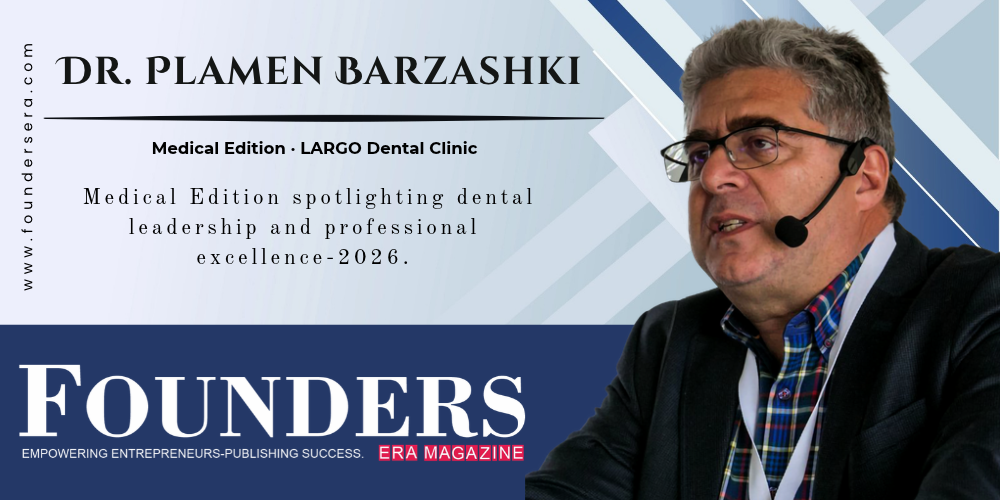
Dr. Plamen Barzashki: Redefining Global Dentistry Through Innovation, Education, and Systematic Excellence
“The future of dentistry will not be defined solely by better technology-it will be defined by how effectively that technology is transformed into accessible, scalable, and human-centered care.”
The global healthcare landscape is undergoing one of the most profound transformations in modern history. Artificial intelligence is reshaping diagnostics; regenerative medicine is redefining treatment possibilities; digital technologies are streamlining patient care, and data-driven decision-making is becoming integral to clinical excellence. Within this rapidly evolving environment, dentistry has emerged as one of healthcare’s most dynamic disciplines, where innovation extends beyond technical advancement to encompass education, accessibility, and systemic transformation.
At the forefront of this evolution stands Dr. Plamen Barzashki, a clinician, educator, entrepreneur, and internationally recognized dental innovator whose work reflects a broader shift in how modern dentistry is practiced, taught, and delivered.
Rather than limiting his influence to clinical excellence alone, Dr. Barzashki has dedicated his career to addressing a fundamental challenge within oral healthcare: ensuring that advanced treatment methodologies become accessible beyond elite institutions and specialist centers. His philosophy extends beyond performing exceptional procedures. Instead, it focuses on creating systems capable of multiplying expertise, empowering professionals, and delivering consistently high standards of care across geographical, cultural, and economic boundaries.
This vision has positioned him among the influential dental leaders shaping the profession’s future.
From Clinical Excellence to Global Impact
Every successful healthcare leader begins with patient care. Few, however, evolve into architects of systems capable of influencing an entire profession.
Dr. Barzashki’s journey began in Bulgaria during the 1990s, where his early years in clinical practice exposed him to one of healthcare’s most persistent realities: exceptional treatment often depended upon geography, economic opportunity, and access to highly specialized expertise. Patients requiring advanced reconstructive procedures frequently faced limited options, while practitioners lacked standardized pathways for mastering increasingly complex techniques.
For many clinicians, these challenges represented unavoidable limitations.
For Dr. Barzashki, they represented opportunities for innovation. He began asking questions that would ultimately define his professional career.
Why should exceptional clinical outcomes depend upon individual talent alone?
Could expertise become teachable?
Could complex surgical procedures be transformed into structured methodologies that consistently produce predictable results?
Most importantly, could world-class dental care become scalable without compromising quality?
These questions gradually evolved into a professional mission that would extend far beyond traditional clinical practice.
Building Systems Instead of Individual Success
One of the defining characteristics of transformative leadership is recognizing that personal success has limited impact unless it can be replicated by others.
Dr. Barzashki embraced this principle early in his professional evolution.
Through advanced international training with respected pioneers in implantology, regenerative surgery, and periodontal medicine, he expanded not only his clinical capabilities but also his understanding of how innovation spreads throughout healthcare systems. Technical excellence, he realized, represented only the beginning.
- Real transformation requires structured education.
- It required repeatable protocols.
- It required systems capable of transferring expertise from one clinician to hundreds.
This philosophy became the foundation of an educational framework that has since trained more than one thousand dental professionals through over 150 advanced courses and international educational programs.
- Rather than measuring success solely by personal patient outcomes, Dr. Barzashki evaluates impact through multiplication.
- Every clinician successfully trained becomes another source of excellence.
- Every standardized protocol expands access to advanced care.
- Every educational initiative contributes to raising clinical standards across the profession.
- In doing so, individual expertise becomes institutional knowledge.
That transition from practitioner to educator, from clinician to systems architect-marks one of the defining themes of his career.
A Philosophy of Systematic Innovation
Modern healthcare often celebrates breakthrough technologies.
Dr. Barzashki argues that breakthroughs alone are insufficient.
Innovation achieves its greatest value only when it becomes systematically accessible.
His philosophy, which he describes as creating “systematic innovation for universal impact,” reflects a comprehensive approach to healthcare transformation. Rather than viewing technological advancement as isolated achievements, he advocates integrated ecosystems combining education, digital technologies, standardized clinical protocols, professional collaboration, and continuous research.
- The objective is not merely improving individual procedures.
- It is transforming entire models of care.
- This systems-oriented perspective distinguishes his work within modern dentistry.
While many practitioners focus on refining technical excellence inside their own practices, Dr. Barzashki concentrates on building frameworks capable of improving outcomes across multiple practices, countries, and healthcare environments simultaneously.
- Such an approach requires balancing innovation with practicality.
- Every protocol must remain scientifically rigorous.
- Every technological integration must produce measurable clinical value.
- Every educational initiative must enable practitioners to deliver predictable outcomes under real-world conditions.
Only then can innovation become scalable.
Addressing Dentistry’s Most Complex Challenges
Contemporary dentistry has achieved remarkable progress in preventive care, implantology, digital workflows, and regenerative procedures. Yet significant disparities remain.
Many patients requiring advanced reconstructive treatment continue to encounter limited access to highly experienced specialists.
Complex implant rehabilitation, severe bone loss, failed previous treatments, and anatomically challenging cases often require exceptional expertise unavailable in many regions.
Recognizing this imbalance, Dr. Barzashki directed much of his recent work toward simplifying complexity without compromising clinical standards.
His methodologies combine biomimetic regenerative techniques, advanced digital planning, artificial intelligence-assisted diagnostics, and structured surgical workflows designed to improve predictability while reducing variability between practitioners.
- Importantly, these innovations do not attempt to replace clinical judgment.
- Instead, they strengthen it.
- Technology becomes an extension of professional expertise rather than a substitute for it.
- This philosophy reflects an increasingly important direction within healthcare innovation.
- The future does not belong to technology alone.
It belongs to technology that empowers clinicians.
Innovation Beyond Borders
Perhaps one of the most compelling demonstrations of Dr. Barzashki’s philosophy can be seen in his work establishing the first modern dental clinic in Zanzibar.
Far from being merely an international expansion project, the initiative illustrates his broader understanding of innovation.
- Resource-constrained environments often demand extraordinary creativity.
- Limited infrastructure encourages simpler, more efficient, and more adaptable clinical solutions.
- Rather than viewing these environments as obstacles, Dr. Barzashki considers them laboratories for innovation.
- Solutions developed under challenging conditions frequently prove more scalable, affordable, and globally relevant than those created exclusively within highly resourced healthcare systems.
- This perspective challenges conventional assumptions about where innovation originates.
- Excellence need not emerge solely from major academic institutions or metropolitan medical centers.
Sometimes the greatest breakthroughs arise where necessity demands entirely new approaches.
By integrating education, clinical service, and innovation within underserved regions, his work demonstrates how dentistry can simultaneously address healthcare disparities while generating solutions applicable worldwide.
It is a model that aligns technological progress with social responsibility.
And increasingly, it represents the future of healthcare leadership.
Transforming Innovation into Global Standards
For any innovation to reshape an industry, it must first earn the confidence of the professionals who define that industry. Throughout his career, Dr. Plamen Barzashki has recognized that the true measure of success lies not only in developing advanced clinical techniques but also in ensuring they become trusted standards that elevate patient care across diverse healthcare environments.
This philosophy has been reflected in the widespread adoption of his methodologies by respected organizations within implant dentistry. Serving as an exclusive trainer for internationally recognized implant systems represents more than professional distinction; it demonstrates confidence in clinical protocols that have consistently delivered predictable outcomes in some of dentistry’s most challenging cases.
Yet Dr. Barzashki views industry recognition as only one indicator of meaningful progress.
For him, the most significant milestone has been proving that clinical excellence can be systematized.
Across a growing network of dental clinics operating in multiple countries, standardized protocols have demonstrated that high-quality care does not need to remain dependent upon a single practitioner’s expertise. Instead, excellence can become embedded within organizational systems, educational frameworks, and collaborative clinical cultures.
This ability to transform personal knowledge into repeatable institutional practice has become one of the defining characteristics of his professional legacy.
Digital Dentistry: Building an Integrated Clinical Ecosystem
Dentistry is currently experiencing one of the most significant technological transitions in its history.
Three-dimensional imaging, digital workflows, artificial intelligence, guided surgery, regenerative biomaterials, and minimally invasive surgical techniques are redefining both diagnosis and treatment. However, while many practices adopt these technologies individually, Dr. Barzashki advocates a fundamentally different approach.
Rather than viewing innovation as a collection of independent tools, he believes the future belongs to integrated treatment ecosystems.
Within his clinical model, advanced imaging, AI-assisted diagnostics, digital treatment planning, 3D-printed surgical guides, biomimetic regenerative materials, and piezoelectric surgery function together as components of a unified workflow. Each technology complements the others, creating greater precision, predictability, and efficiency throughout the patient’s journey.
This systems-based integration minimizes variability while improving communication between clinicians, laboratories, and patients. More importantly, it enables complex procedures to become increasingly standardized, making advanced treatments more accessible to practitioners who follow established protocols.
The result is not simply better technology.
It is better for clinical decision-making.
Artificial Intelligence as a Clinical Partner
Artificial Intelligence has become one of the defining conversations in modern healthcare. While much public discussion focuses on automation and machine learning, Dr. Barzashki emphasizes a more balanced perspective.
He views AI not as a replacement for clinical expertise but as a sophisticated partner capable of enhancing professional judgment.
Complex radiographic analysis, treatment planning, anatomical risk assessment, and predictive outcome evaluation increasingly benefit intelligent algorithms capable of identifying subtle patterns within vast amounts of clinical data. Such capabilities allow practitioners to make more informed decisions while reducing uncertainty during complex procedures.
However, Dr. Barzashki consistently stresses that technology should never replace the human relationship between clinicians and patients.
- Trust remains deeply personal.
- Empathy cannot be automated.
- Clinical wisdom extends beyond data interpretation to include communication, ethical reasoning, emotional intelligence, and individualized care.
- Artificial Intelligence therefore achieves its greatest value when it supports- not substitutes for- the expertise of experienced healthcare professionals.
This human-centered philosophy reflects one of the central themes of his work: technology should enhance compassion rather than diminish it.
Research Driven by Clinical Reality
Innovation in medicine requires more than creative ideas.
It demands rigorous validation.
Throughout his career, Dr. Barzashki has sought to ensure that research remains closely connected to real-world clinical practice rather than existing solely within academic environments.
His involvement with professional organizations focused on dental research, innovation, and Artificial Intelligence places him at the intersection of emerging technologies and evidence-based medicine. Equally significant is the role of his international clinical network, which functions as an ongoing source of practical research.
- Every treatment contributes to valuable clinical information.
- Every patient outcome generates insight.
- Every refinement strengthens future protocols.
This continuous feedback cycle enables innovations to evolve through practical experience rather than theoretical assumptions alone.
Collaborations with respected scientific organizations and industry partners further reinforce this approach, creating opportunities to refine clinical methodologies while contributing to the development of new materials, technologies, and educational initiatives.
For Dr. Barzashki, research is not an isolated activity.
It is integrated into everyday patient care.
Data as a Foundation for Better Outcomes
Modern healthcare increasingly recognizes the importance of measurable outcomes.
Clinical excellence is no longer defined solely by technical success during treatment but also by long-term patient recovery, satisfaction, quality of life, and procedural predictability.
Dr. Barzashki has embraced this evidence-driven philosophy by placing outcome analysis at the center of clinical decision-making.
Through systematic data collection across multiple practices and patient populations, his teams continuously evaluate treatment performance, identify emerging trends, and refine clinical protocols.
When outcome data reveals opportunities for improvement, methodologies evolve accordingly.
This adaptive approach has supported modifications to surgical techniques, enhanced recovery protocols, and personalized treatment pathways designed to improve patient experiences while reducing complications.
Importantly, the international diversity of patients treated across different countries provides valuable insight into how genetic, cultural, environmental, and socioeconomic factors influence oral health.
Rather than seeking one universal solution, Dr. Barzashki advocates adaptable systems capable of maintaining consistently high standards while respecting regional differences.
Such flexibility represents an increasingly important characteristic of modern global healthcare.
Human-Centered Dentistry
Despite his enthusiasm for technological innovation, conversations with Dr. Barzashki consistently return to one central principle:
Dentistry remains fundamentally about people.
Every digital workflow, every surgical protocol, and every technological advancement ultimately serve one purpose-improving the lives of patients.
For this reason, emotional intelligence occupies an essential place within his philosophy of clinical excellence.
Patients often experience anxiety, uncertainty, or fear when undergoing complex dental treatment. Technical competence cannot address these emotional realities.
Effective communication, empathy, transparency, and individualized attention remain equally important components of successful care.
Within the educational frameworks developed by Dr. Barzashki, practitioners receive guidance not only in surgical precision but also in understanding patient expectations, cultural perspectives, and interpersonal communication.
This holistic philosophy recognizes that outstanding clinical outcomes and exceptional patient experiences are inseparable.
Modern dentistry demands both.
Mentorship as a Multiplier of Excellence
One of the most enduring aspects of Dr. Barzashki’s career has been his commitment to professional education.
Having trained more than one thousand clinicians through advanced educational programs, he regards mentorship as one of the profession’s greatest responsibilities.
Knowledge gains its greatest value when shared.
Every practitioner who masters advanced regenerative procedures, digital workflows, or minimally invasive surgical techniques expands access to quality care for countless future patients.
Education therefore becomes one of healthcare’s most powerful forms of innovation.
By investing in clinicians rather than simply expanding clinics, Dr. Barzashki has multiplied his impact far beyond the patients he could personally treat.
His influence continues through every professional who applies those principles within their own communities.
That multiplier effect represents perhaps the most meaningful measure of lasting leadership.
Read More: Dr. Plamen Barzashki – Founders ERA Medical Edition